Chihuahua Health Testing: Why "I Know My Lines" Is Not Enough
Rev. T. Stringer · · 6 min read

By Rev. T. Stringer, Lead Researcher, SIPGS
"I know my lines."
Every breeder has heard it.
Many have said it.
But no one can see a recessive gene by looking at a dog.
A carrier looks exactly like a clear dog.
It can hide for generations, then show up in a litter.
This post covers how breeders used to find hidden genes, what to test in a Chihuahua today, what our own data shows, and what no test can tell you yet.
Why you can't "know" a recessive gene
A recessive condition needs two copies to show.
A dog with one copy is a carrier.
Carriers are healthy.
Carrier bred to a clear dog:
No puppy is affected.
About half the puppies are carriers.
Nothing shows. The gene quietly spreads.
Carrier bred to a carrier:
About 1 in 4 puppies is affected.
This is often the first time anyone learns the gene was there.
A popular stud who is a carrier can pass the gene to hundreds of descendants before the first affected puppy appears.
See our post on popular sire syndrome.
How breeders used to find carriers: test breeding
Before DNA tests, breeders used test breeding.
George Padgett, DVM, describes it in Control of Canine Genetic Diseases.
A dog suspected of carrying a gene was bred to a known carrier or an affected dog.
The puppies were watched.
If any were affected, the suspect was a carrier.
The problems:
- Litters were bred knowing some puppies could be born sick.
- It took many litters, and years, to get an answer.
- A clean litter did not prove a dog was clear. It only made it less likely.
DNA testing ended the need for this.
Today a cheek swab can tell you if a dog is a carrier, with no litter at all.
What to test in a Chihuahua
1. OFA health exams
The Chihuahua Club of America recommends three:
- Patella (knees). The most common joint problem in the breed.
- Heart. An exam by a vet, or a cardiologist, for murmurs and defects. We go further: every A & A's dog gets an advanced cardiac exam, an echocardiogram by a cardiologist, at 1 year, before it is ever bred. An echo shows the heart's structure and valves, not just what can be heard.
- Eyes. An exam by a board-certified veterinary ophthalmologist.
These are exams of the dog's body.
No DNA test replaces them.
All OFA results are public at:
ofa.org
2. A DNA panel
A panel like Embark checks hundreds of single-gene conditions from one swab.
For Chihuahuas, Embark lists these as breed-relevant:
- Congenital Cornification Disorder (Chihuahua variant)
- Intervertebral Disc Disease, Type I (CDDY)
- Neuronal Ceroid Lipofuscinosis 7 (NCL7)
- Progressive Retinal Atrophy, crd4/cord1
- Progressive Retinal Atrophy, prcd
- Spinocerebellar Ataxia (KCNJ10)
The panel also gives:
- coat color genes, including merle
- genetic diversity and inbreeding (COI)
What SIPGS found in 117 Chihuahua health reports
SIPGS holds DNA data on more than 380 Chihuahuas.
For this post, we read the full Embark health results for 117 of them.
All are 100% Chihuahua.
Breed-relevant conditions
Across those six conditions, we found:
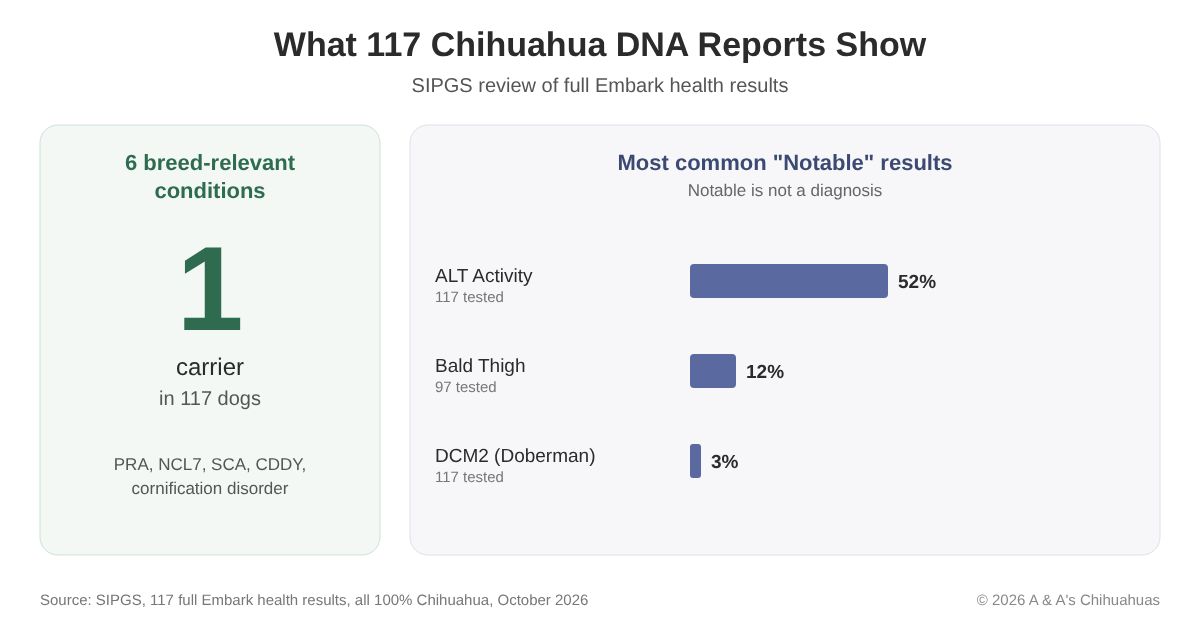
1 carrier in 117 dogs
One dog carries PRA crd4/cord1.
Every other result was clear.
(The cornification disorder test was added later and is on 56 of the reports.)
The results that show up most as "Notable":
- ALT Activity: 61 of 117 dogs (52%)
- Bald Thigh Syndrome: 12 of 97 dogs tested (12%)
- DCM2, a Doberman heart variant: 3 of 117 dogs (3%)
Some conditions were added to the panel later, so fewer dogs were tested for them.
"Notable" does not mean sick
A Notable result means the dog has at least one copy of a variant.
It does not mean the dog has, or will get, a disease.
ALT Activity is not a disease.
It means the dog may have a lower normal reading for the liver enzyme ALT.
Tell your vet, so bloodwork is read correctly.
GH1 "Proportionate Dwarfism" is not supported by the evidence.
The test is based on one sick puppy.
In 334 SIPGS Chihuahuas, all 12 dogs with two copies are healthy and normal size.
See our post on GH1 proportionate dwarfism.
Variants found in other breeds may act differently in a Chihuahua, or not at all.
Read every result this way:
- How many copies?
- Is it recessive or dominant?
- How strong is the evidence in this breed?
What no DNA test can tell you yet
Many of the problems that matter most in Chihuahuas have no single-gene test:
- patellar luxation
- heart valve disease
- collapsing trachea
- hydrocephalus
- adult size
These are shaped by many genes.
They are found by:
- OFA exams
- lifelong health records
- pedigrees that link every dog to its relatives
That is what SIPGS is built for.
We combine DNA, pedigree, and health records on every dog.
That shows which families carry which problems, even where no single test exists.
Merle: test before you breed
Merle bred to merle can produce double merles.
Double merles have a high risk of eye defects and deafness.
Some merle dogs do not look merle.
A DNA test can find merle that the eye cannot see.
Test every dog in a merle program.
See our post on merle in Chihuahuas.
Genetic diversity
A DNA panel can measure how inbred a dog is.
Lower inbreeding means less chance that two copies of a hidden gene meet.
Diversity also means a stronger immune system.
The immune system depends on a set of genes called DLA, the dog version of the human MHC.
These genes decide which germs the body can recognize.
A dog with two different versions of a DLA gene can recognize a wider range of germs.
A dog with two identical copies recognizes fewer.
Some DLA types are also tied to autoimmune disease, such as low thyroid and diabetes.
Embark reports DLA diversity on every dog.
We use it, along with inbreeding, when we plan pairings.
Do not drop a good dog for one carrier result.
Pair it with a clear dog instead.
What puppy buyers should ask a breeder
- Are the parents OFA tested for knees, heart, and eyes? Can I see the results on ofa.org?
- Are the parents DNA tested? Can I see the reports?
- Are any results Notable? What do they mean for this puppy?
- What do you know about health problems in the grandparents and relatives?
A breeder who shares every result, good or bad, has nothing to hide.
At A & A's Chihuahuas, we share all of ours.
Quick answers
What health tests should a Chihuahua have?
OFA patella, heart, and eye exams, plus a DNA panel.
What does "Notable" mean on an Embark report?
The dog has at least one copy of a variant.
It is not a diagnosis.
What is test breeding?
Breeding a suspected carrier to a known carrier and watching the puppies.
DNA testing has replaced it.
Can a DNA test find patellar luxation?
No.
Knees must be examined by a vet.
Why does genetic diversity matter?
Less inbreeding means fewer hidden genes meeting.
More variety in the immune genes (DLA) means the body can recognize more germs.
Is a carrier dog safe to breed?
Yes.
Pair it with a clear dog and no puppy will be affected.
Key takeaways
- No one can see a recessive gene. Carriers look normal.
- Test breeding found carriers by producing sick puppies. DNA testing replaced it.
- A Chihuahua needs OFA patella, heart, and eye exams, plus a DNA panel. We add an echocardiogram at 1 year, before breeding.
- In 117 SIPGS Chihuahuas, the six breed-relevant conditions turned up just 1 carrier.
- "Notable" is not a diagnosis. Read each result for copies, inheritance, and evidence.
- The biggest Chihuahua problems have no single-gene test. Records and pedigrees fill the gap.
- Test every merle program for hidden merle.
- Breed carriers to clear dogs. Do not throw away good dogs.
- Genetic diversity protects against hidden genes and supports a stronger immune system.
Sources
- Padgett GA. (1998). Control of Canine Genetic Diseases. Howell Book House.
- Chihuahua Club of America. CHIC and health testing recommendations.
- American Kennel Club. Toy Group health testing requirements: Chihuahua.
- Orthopedic Foundation for Animals. ofa.org.
- Kennedy LJ, et al. (2006). Association of canine hypothyroidism with a common major histocompatibility complex DLA class II allele. Tissue Antigens, 68:82-86.
- Embark Veterinary. Full health results, 117 Chihuahuas.
- Stringer, T.A. (ongoing). Stringer Integrated Pedigree-Genomic Study (SIPGS).
© 2026 A & A's Chihuahuas and Rev. T. Stringer. All rights reserved.
This educational content may not be reproduced without permission.
- Health Testing
- Genetics
- Breeding