GH1 "Proportionate Dwarfism" in Chihuahuas: A Test Built on One Dog
Rev. T. Stringer · · 7 min read

By Rev. T. Stringer, Lead Researcher, SIPGS
Many Chihuahua owners open their Embark report and see this:
Proportionate Dwarfism (GH1 Exon 5, Chihuahua Variant): Notable
It sounds alarming.
Our data says it should not be.
This post explains where the test came from, what is wrong with the evidence behind it, and what SIPGS found in 334 Chihuahuas.
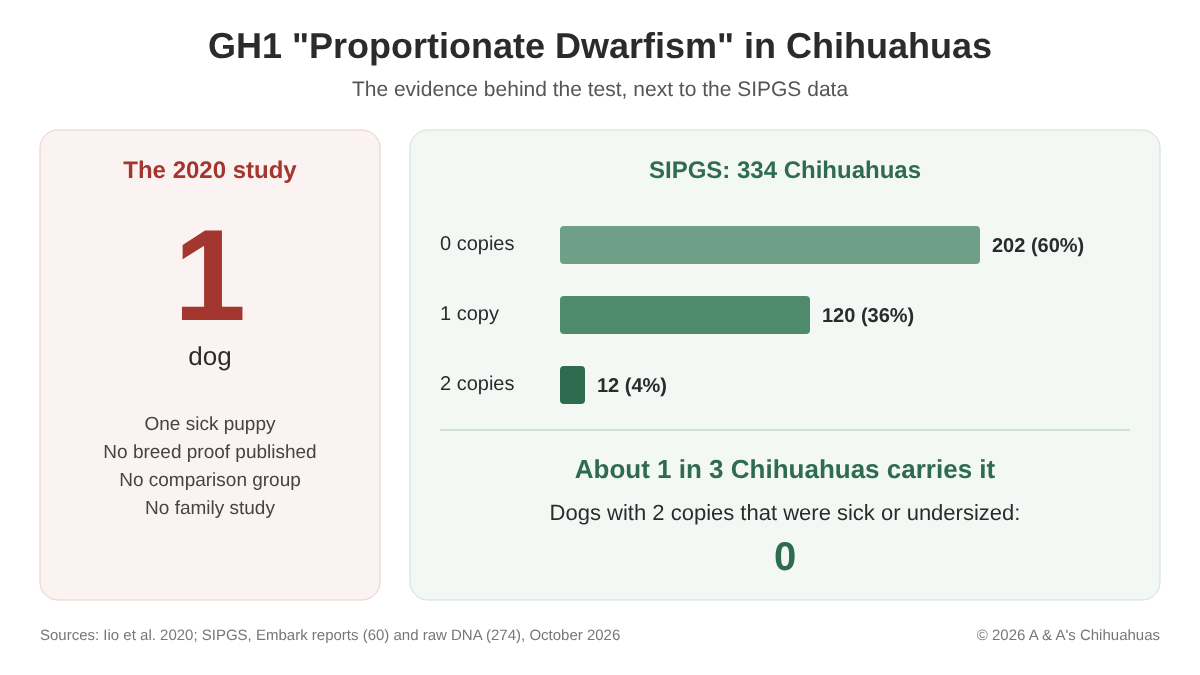
One dog behind the test. 334 dogs in our data.
What proportionate dwarfism means
"Proportionate" means the whole dog is smaller, but in normal proportion.
Legs, body, and head stay in balance.
"Disproportionate" dwarfism is different.
That is short legs on a normal-size body, like a Dachshund or Corgi.
It is caused by other genes.
The GH1 gene
GH1 makes growth hormone.
Growth hormone tells the body to make IGF-1, which drives growth.
The Chihuahua variant removes 6 letters of DNA from GH1.
The protein is still made, with a small change.
Where the test came from: one dog
The variant was reported in 2020, from one Chihuahua in Japan.
She was a 6-month-old female with:
- repeated low blood sugar and collapse
- small size, in proportion
- a retained puppy coat
- retained baby teeth
- open soft spots on the skull
- very low IGF-1
A growth hormone test showed she was not making enough growth hormone.
She had two copies of the variant.
Her illness was real.
The question is whether this variant caused it.
Why the evidence is weak
1. One dog.
The published evidence is one affected puppy.
No study has followed a group of dogs with the variant.
2. No proof she was a Chihuahua.
The report calls her a Chihuahua.
Nothing published shows her breed was confirmed by pedigree or by a DNA breed test.
A small mixed-breed dog brings in genes from other breeds, including other causes of poor growth.
3. No proof the change breaks the protein.
No published lab work shows that the changed growth hormone fails to work.
4. Only one gene was checked.
Growth hormone deficiency has other causes.
Finding one DNA change in one sick dog does not show that change is the cause.
5. The signs are common in every toy breed.
Low blood sugar, retained baby teeth, and small size are seen in toy puppies with no GH1 variant at all.
An open soft spot on the skull, the molera, is common in Chihuahuas.
The AKC standard allows it.
In this breed it is not a sign of disease.
6. No one has rated it.
OMIA, the main catalog of inherited dog conditions, lists this variant as "not currently evaluated" for disease.
What SIPGS found
We used two sources.
1. Original Embark reports: 60 Chihuahuas
Reports from before 2021 did not include this test.
2. Raw DNA data: 274 more Chihuahuas
The GH1 change is not in Embark's raw data file.
So we used the DNA around it.
Dogs with the variant share a stretch of DNA around the gene.
We learned that pattern from 42 dogs with both a report and raw data.
Then we read it in the other dogs.
We tested the method first.
We hid the real result for each of the 42 dogs, then predicted it.
42 of 42 were correct.
We kept only dogs called with at least 90% confidence.
Combined result: 334 Chihuahuas
- 0 copies: 202 dogs (60%)
- 1 copy: 120 dogs (36%)
- 2 copies: 12 dogs (4%)
About 1 in 3 Chihuahuas carries the variant.
The math does not fit a disease
The variant makes up:
22% of all copies
At that level, the share of Chihuahuas born with 2 copies is about:
1 in 20
If 2 copies caused growth hormone dwarfism, vets would see it in Chihuahuas every week.
They don't.
One case has been published.
In human genetics, a variant this common is classed as harmless for a rare, severe recessive disease.
A real cause of a rare disease is rare itself.
The dogs themselves
We have 12 dogs with 2 copies.
Not one has been sick.
Across every SIPGS dog tested for this variant, with 0, 1, or 2 copies, not one has shown the signs in the 2020 case:
- no collapse from low blood sugar
- no retained puppy coat
- no retained baby teeth
- no dwarfism
- no small size: every one is a normal-size Chihuahua
Embark's own reports on 2-copy dogs say they are "not known to be at increased risk."
Embark's condition page says most dogs with two copies need no more care than any other toy breed puppy.
What about size?
Every SIPGS dog tested for this variant is a normal size for a Chihuahua.
That includes all 12 dogs with 2 copies.
Some dogs with 2 copies are larger than some dogs with 0 copies.
If 2 copies caused dwarfism, the 2-copy dogs would be the smallest.
They are not.
SIPGS is adding scale weights to every tested dog to put exact numbers on this.
For more on what the size genes can and cannot predict, see our post on Chihuahua size.
Should this be on a DNA health panel?
In my view, no.
A health test tells breeders and buyers that a DNA change causes disease.
This one has not earned that.
The bar it has not met:
- More than one affected dog
- Proof of breed
- Healthy dogs compared with affected dogs
- Families showing the variant travels with the illness
- Lab proof that the protein does not work
The harm it does:
- About 1 in 3 Chihuahuas gets a "Notable" result.
- Buyers pass on healthy puppies.
- Breeders drop healthy carriers, and the breed loses diversity for nothing.
- Embark's own reports then tell owners of 2-copy dogs that the dog is "not known to be at increased risk."
A result that is flagged and then called no risk confuses everyone.
Until better evidence exists, this variant should come off the health panel.
At most, it belongs in a research section, clearly marked as unconfirmed.
What this means for breeders
- Do not choose or reject a dog on this result.
- Do not remove carriers. That would drop 1 in 3 dogs for no proven reason.
- Raise every toy puppy the same way: frequent meals, warmth, and a sugar source on hand. See our post on hypoglycemia in Chihuahua puppies.
- Record adult weights.
What this means for puppy buyers
A "Notable" GH1 result is not a reason to pass on a puppy.
It is not a diagnosis.
Ask how the puppy is growing and eating.
If a puppy really is not growing
Growth hormone deficiency can be tested directly:
- an IGF-1 blood level
- a growth hormone stimulation test
These test the dog, not a single DNA letter.
Quick answers
What does a "Notable" GH1 result on Embark mean?
The dog has 1 or 2 copies of a GH1 variant reported in one sick puppy in 2020.
It is not a diagnosis.
Is a Chihuahua with 2 copies of GH1 a dwarf?
Not in our data.
All 12 of our 2-copy dogs are normal size and healthy.
How common is the GH1 variant in Chihuahuas?
About 1 in 3 Chihuahuas carries it.
In 334 dogs, 36% had 1 copy and 4% had 2.
Should I avoid a puppy with this result?
No.
Judge the puppy by how it grows and eats.
Key takeaways
- The GH1 test is based on one sick puppy, reported in 2020. Her breed was never shown to be confirmed.
- No published study shows this variant causes disease.
- In 334 SIPGS Chihuahuas: 60% had 0 copies, 36% had 1, and 4% had 2.
- At 22% of all copies, a disease variant would affect about 1 in 20 Chihuahuas. That is not what vets see.
- None of our 12 dogs with 2 copies has been sick. No SIPGS dog tested for it has shown the signs in the 2020 case.
- Do not select for or against this result.
- In our view, it should not be on a DNA health panel until it is backed by real evidence.
- All our tested dogs are normal size. Some with 2 copies are larger than some with 0 copies.
Help us build the size data.
If your Chihuahua has a GH1 result on Embark and is at least 1 year old, send us:
- the Embark profile link
- the GH1 result: 0, 1, or 2 copies
- the dog's adult weight from a scale
- the dog's age when weighed
Contact:
healthresearchataa@gmail.com
Sources
- Iio A, Maeda S, Yonezawa T, Momoi Y, Motegi T. (2020). Isolated growth hormone deficiency in a Chihuahua with a GH1 mutation. Journal of Veterinary Diagnostic Investigation, 32:733-736.
- OMIA 001473-9615. Dwarfism, growth-hormone deficiency in the dog.
- Embark Veterinary. Proportionate Dwarfism (GH1 Exon 5, Chihuahua Variant).
- Embark Veterinary. Original health reports, 60 Chihuahuas, and raw DNA data, 380 Chihuahuas.
- Richards S, et al. (2015). Standards and guidelines for the interpretation of sequence variants. Genetics in Medicine, 17:405-424.
- Browning BL, et al. (2021). Fast two-stage phasing of large-scale sequence data. American Journal of Human Genetics, 108:1880-1890.
- Stringer, T.A. (ongoing). Stringer Integrated Pedigree-Genomic Study (SIPGS).
© 2026 A & A's Chihuahuas and Rev. T. Stringer. All rights reserved.
This educational content may not be reproduced without permission.
- Genetics
- DNA Testing
- Health