Bobtail Chihuahuas: History, Genetics, and Where the Gene May Come From
Rev. T. Stringer · · 7 min read

By Rev. T. Stringer, Lead Researcher, SIPGS
Some Chihuahuas are born with a short tail, or almost no tail at all.
Some people call them crossbred. Some call them a defect.
The history and the DNA say something different.
What is a natural bobtail?
A natural bobtail is a short tail that is there at birth.
It is not docked, injured, or changed by surgery.
In Chihuahuas, it ranges from a little short to almost no tail.
Bobtails were accepted for 68 years
The 1934 AKC Chihuahua standard says:
"TAIL: Moderately long, when not a natural bob, or tail-less. Carried sickle, either up or out, but not tucked under. Hair on the tail in harmony with the coat of the body, preferred furry. Bob-tails and tail-less, so born, are not against a good dog."
The only tail disqualification in 1934 was a cropped tail, meaning a tail cut by a person.
That wording stayed through the 1954 revision.
From the first AKC registration in 1904 until 1972, bobtailed Chihuahuas could show and win.
That is:
68 years
Who changed the rule, and why
The AKC does not write breed standards.
The parent club writes them, and the AKC approves them.
For Chihuahuas, that is the Chihuahua Club of America (CCA).
The CCA added bobtail as a disqualification in 1972.
It was a show-ring choice made by breeders, not a health ruling.
The CCA did not publish a reason.
One clue comes from Denlinger's 1956 breed book.
He wrote that a short tail "does not look quite right," "possibly because we are not used to seeing it."
He also wrote that a tail "cleverly docked by a good surgeon" is "almost impossible to tell from a naturally short tail."
So looks, and the problem of spotting docked tails, may have played a part.
We are requesting CCA records to find out.
It is not the T gene
In most bobtailed breeds, the short tail comes from one change in the T gene, called C189G.
- One copy makes a short tail.
- Two copies kill the puppy before birth.
- There is a DNA test for it, often called "T locus" or "Natural Bobtail."
In 2009, researchers tested 23 short-tailed breeds for this change.
17 carried it. 6 did not:
- Boston Terrier
- English Bulldog
- King Charles Spaniel
- Miniature Schnauzer
- Parson Russell Terrier
- Rottweiler
The authors wrote that "there must be yet other genetic factors affecting tail phenotypes to be discovered."
Meet Lulu
In October 2022, Lulu, a naturally bobtailed Chihuahua, was tested at Paw Print Genetics.
Her T locus result:
t/t: normal tail. No T gene change.
Lulu was born with a bobtail, so her bobtail comes from a different gene.
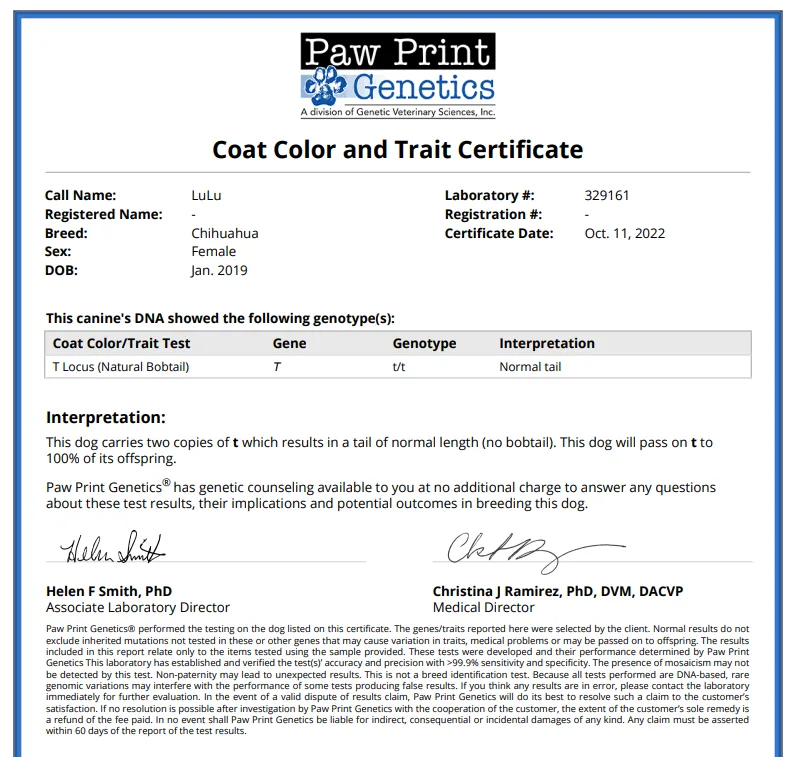
Lulu's official Paw Print Genetics DNA certificate, T Locus result: t/t (Normal Tail). No T-gene bobtail mutation present. Yet Lulu has a natural bobtail.
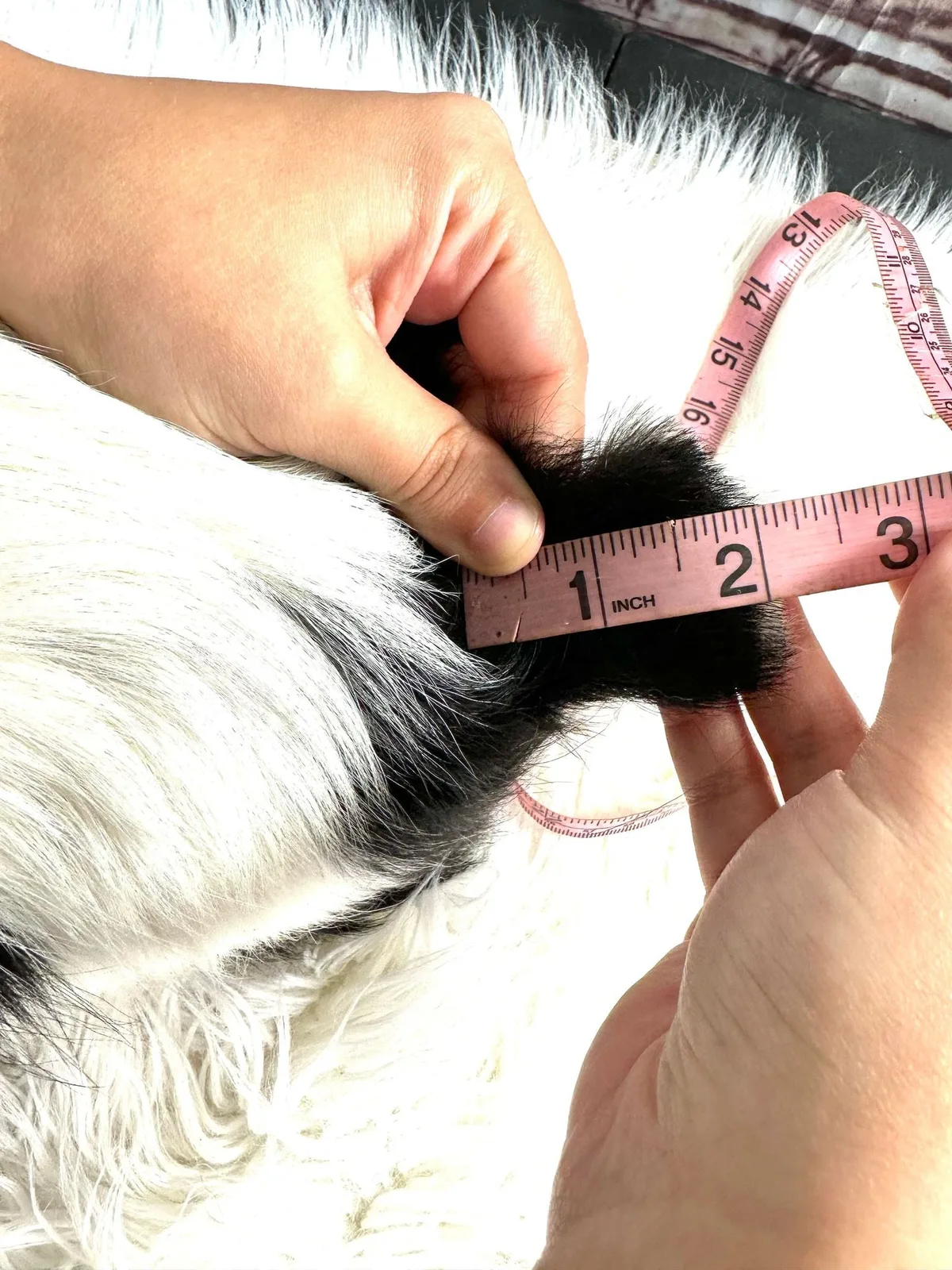
Lulu, a natural bobtail Chihuahua who tested t/t (no T-gene mutation)
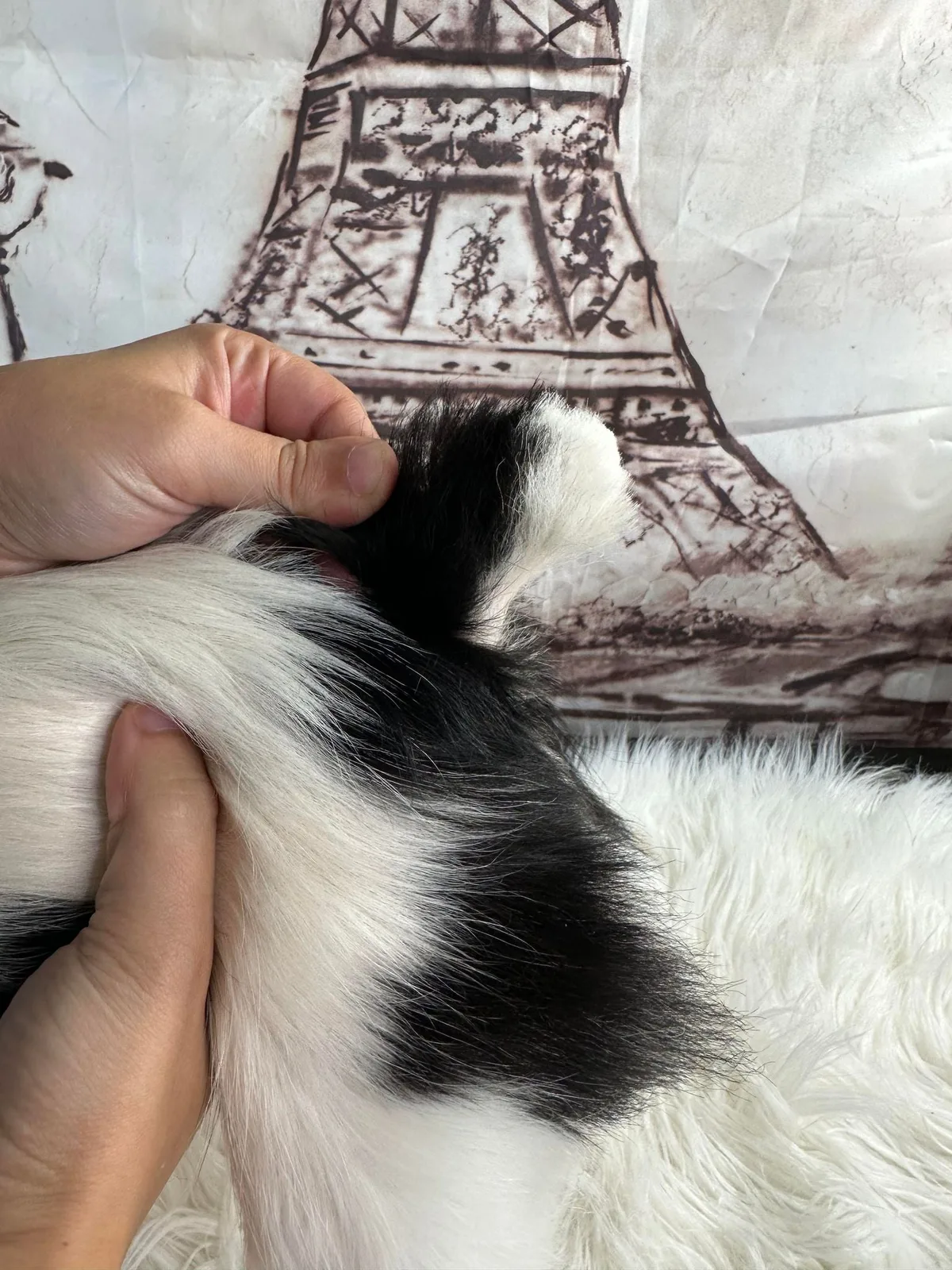
Lulu's natural bobtail, present from birth
It is not the screw-tail gene either
A second known short-tail gene, DVL2, causes the twisted screw tail in Bulldogs, French Bulldogs, and Boston Terriers.
When researchers tested 385 dogs from 43 other breeds, none carried it.
It has not been reported in Chihuahuas.
So the Chihuahua bobtail looks like a third, still unnamed, gene.
It is not lethal, and not a health problem
With the T gene, breeding bobtail to bobtail loses about 1 in 4 puppies.
The Chihuahua bobtail is different.
We know of a breeder who breeds only bobtail to bobtail.
If two copies were lethal, that program could not work.
We also know of no health problem linked to the natural bobtail in Chihuahuas.
Lulu and the other bobtailed dogs we know are sound and healthy.
Where does the gene come from?
It rides with the oldest lines
Experienced breeders see bobtails most in the oldest show lines, not at random across the breed.
Lulu fits that pattern exactly.
Her parents are Leonard and Libby. Both are in our Stringer Integrated Pedigree-Genomic Study (SIPGS).
- Sire line: Leonard's straight male line runs back about 25 generations to Little Pedro, registered in the 1920s. 83% of the Chihuahua males we DNA tested carry this same male line.
- Dam line: Libby's straight female line runs back to Babe, a US-born female recorded about 1900. It is the only dam line in SIPGS that reaches that far.
The breed's roots are Old World
SIPGS read the maternal DNA of 97 Chihuahuas from raw Embark files.
Every type we could place is a published Old World dog lineage.
Ancient DNA from Roman dogs in Augusta Raurica (modern Switzerland, about 200 to 300 CE) matches these lines exactly.
One of those Roman dogs was a small adult, only:
27 cm (about 10.5 inches) at the withers
Small dogs with the same mother lines as our Chihuahuas were in Europe about 1,800 years ago.
No bobtail breed is a close relative
We compared 131 SIPGS Chihuahuas with about 190 breeds and dog groups from a 2015 study of 5,406 dogs.
Here is where the breeds with natural short tails ranked for shared ancestry:
- Brittany
Short tail gene: T gene
Rank: 15 - Jack Russell Terrier
Short tail gene: T gene
Rank: 31 - Miniature Schnauzer
Short tail gene: Unknown, not T
Rank: 61 - Pembroke Welsh Corgi
Short tail gene: T gene
Rank: 69 - Schipperke
Short tail gene: T gene
Rank: 70 - Rottweiler
Short tail gene: Unknown, not T
Rank: 93 - Australian Shepherd
Short tail gene: T gene
Rank: 102
The Chihuahua's closest relatives are other toy and companion breeds.
None of them is known for a natural bobtail.
Our theory
The DNA does not point to a breed the Chihuahua borrowed its bobtail from.
Our theory: the bobtail is an old variant inside the Chihuahua itself, carried in the foundation lines since before the breed was registered.
This is a theory, not a proven result.
To test it, we need to compare the DNA of bobtailed and long-tailed Chihuahuas from the same lines.
The Malta "pocket dog" is a Chihuahua
The old version of this post linked the bobtail to a Maltese "pocket dog," the Kelb tal-But.
Our research settled it.
In 2001, Malta issued a 35c stamp reading "Kelb tal-But."
Stamp catalogues list it as Chihuahua, and "Kelb tal-But" is the everyday Maltese name for the breed.
It is not a separate ancient breed, and it does not tell us where the bobtail came from.
Two kinds of bobtail, side by side
- Gene known?
T gene bobtail: Yes, T (C189G)
Chihuahua bobtail: Not yet - DNA test?
T gene bobtail: Yes
Chihuahua bobtail: No - Two copies lethal?
T gene bobtail: Yes
Chihuahua bobtail: No - Found in
T gene bobtail: 17+ breeds
Chihuahua bobtail: Chihuahua, in the old foundation lines
For breeders, and how you can help
- A t/t T locus result does not rule out the Chihuahua bobtail.
- There is no DNA test for it yet. Track it by eye and by pedigree.
If you own a naturally bobtailed Chihuahua, you can help find the gene:
- DNA test with Embark and share the raw data with SIPGS.
- Test the T locus to confirm it is not the T gene.
- Photograph and measure the tail from birth.
- Record the pedigree and which lines carry bobtails.
Contact:
Key takeaways
- Bobtails were accepted in AKC Chihuahuas for 68 years. The CCA disqualified them in 1972 as a show-ring choice.
- The Chihuahua bobtail is not the T gene and not the screw-tail gene. It is still unnamed.
- It is not lethal. Bobtail to bobtail breeding works.
- It rides with the oldest lines. Lulu's sire and dam lines reach Little Pedro and Babe.
- No bobtail breed is a close relative. We think it is an old Chihuahua variant.
- There is no test yet. Your dogs can help find it.
Sources
- AKC Chihuahua Breed Standard, approved August 14, 1934.
- Denlinger, M. (1956). The Complete Chihuahua, pp. 84-85.
- Haworth K, Putt W, Cattanach B, et al. (2001). Canine homolog of the T-box transcription factor T; failure of the protein to bind to its DNA target leads to a short-tail phenotype. Mammalian Genome, 12(3):212-218.
- Hytönen MK, Grall A, Hédan B, et al. (2009). Ancestral T-box mutation is present in many, but not all, short-tailed dog breeds. Journal of Heredity, 100(2):236-240.
- Mansour TA, et al. (2018). Whole genome variant association across 100 dogs identifies a frame shift mutation in DISHEVELLED 2 which contributes to Robinow-like syndrome in Bulldogs and related screw tail dog breeds. PLOS Genetics, 14(12):e1007850.
- Granado J, et al. (2023). Ancient dog mitogenomes from Roman Augusta Raurica.
- Shannon LM, et al. (2015). Genetic structure in village dogs reveals a Central Asian domestication origin. PNAS, 112(44):13639-13644.
- Ní Leathlobhair M, et al. (2018). The evolutionary history of dogs in the Americas. Science, 361(6397):81-85.
- Paw Print Genetics. (2022). Coat Color and Trait Certificate, T Locus (Natural Bobtail), Lulu. Lab #329161, October 11, 2022.
- Stringer, T.A. (ongoing). Stringer Integrated Pedigree-Genomic Study (SIPGS).
© 2026 A & A's Chihuahuas and Rev. T. Stringer. All rights reserved.
This educational content may not be reproduced without permission.
- history of chihuahua
- Dog Breeding
- genetics
- Chihuahuas
- bobtail in chihuahuas
- health issues in chihuahuas