Inguinal Hernias in Female Chihuahuas: After Whelping, Signs, and Repair
Rev. T. Stringer · · 4 min read
By Rev. T. Stringer, Lead Researcher, SIPGS
An inguinal hernia is a bulge in the groin.
It is most often found in older, unspayed females.
In toy breeds, it often shows up after a female has had litters.
Most are soft and cause no trouble.
Some hold a loop of intestine or the uterus.
Those need surgery.
What it is
The inguinal canal is a small opening in the belly wall, in the groin.
Blood vessels and nerves pass through it.
In females, this opening is larger than in males.
If the ring around the opening stretches or weakens, belly contents can push through.
That makes the bulge.
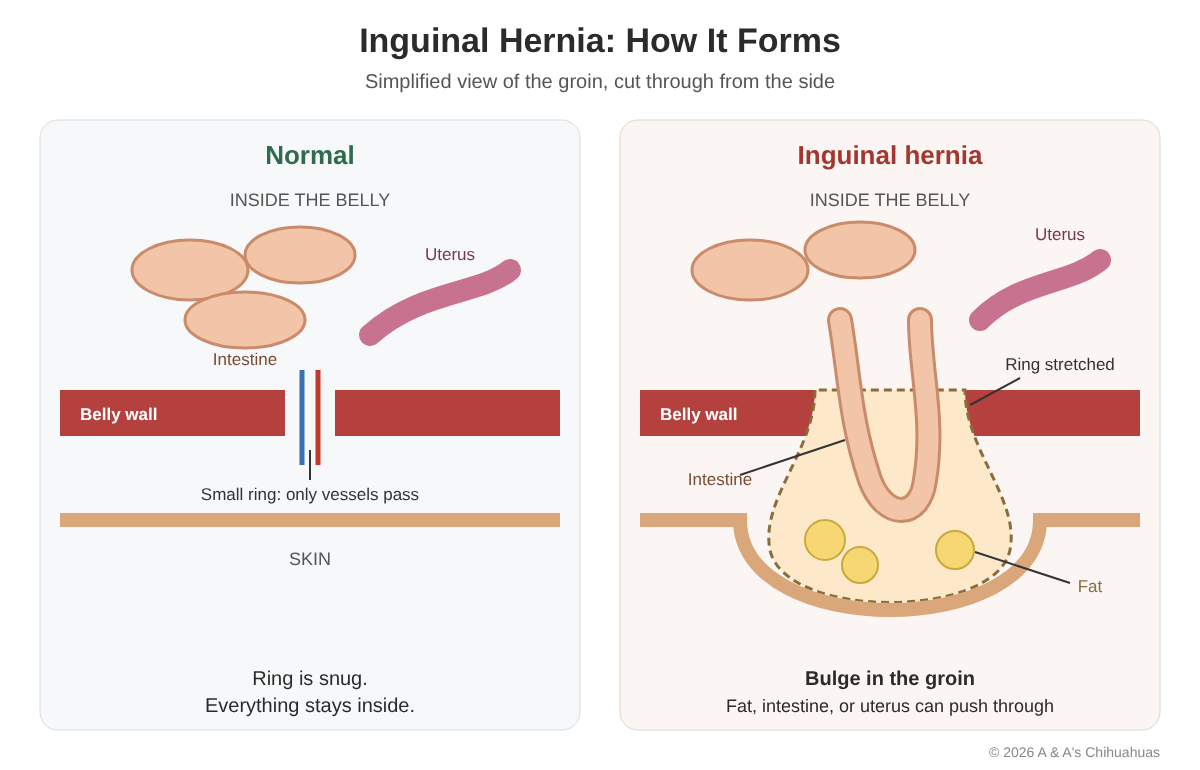
A normal ring (left) and an inguinal hernia (right).
What can push through:
- fat
- omentum (the fatty apron that covers the gut)
- a loop of small intestine
- the uterus
- the bladder
Who gets it
A 2020 study looked at 41 dogs repaired for this kind of hernia.
All weighed under:
10 kg (22 lb)
Median weight:
5 kg (11 lb)
Of the 41 dogs:
- 34 were females.
- 30 of the 34 females were not spayed. That is 88%.
- 80% were over 5 years old.
- The median age was 9 years.
Left side: 30 of 41 dogs, or 73%.
Both sides: 2 dogs.
So the usual patient is a small, unspayed female in middle age or older.
That describes many retired breeding females.
Why females after whelping
1. Hormones.
Estrogen is thought to weaken the inguinal ring.
That is the main reason unspayed females get it more often.
Every heat cycle and every pregnancy adds more exposure.
2. Pregnancy.
Hormones in pregnancy are thought to widen the ring further.
The growing uterus also pushes outward on the belly wall.
3. Strain.
Labor, large litters, and long pushing put pressure on the groin.
4. Body condition.
Extra fat can sit in the canal and hold it open.
Is it genetic?
We don't know yet.
No study has shown how inguinal hernias are inherited in dogs.
What we do know:
- Some breeds are over-represented. Miniature Dachshunds were 63% of the dogs in the 2020 study.
- West Highland White Terriers, Pekingese, and Cairn Terriers are listed as at risk for the inborn type.
- It can show up in more than one female in the same family.
It is a different problem from an umbilical hernia.
An umbilical hernia is at the belly button and is present from birth.
An inguinal hernia in a female usually appears later in life.
For breeders:
- Record every inguinal hernia, with the dog's age and how many litters she had.
- Note which side.
- Note the dam and sire.
- If several related females develop one, treat it as a family trait when planning pairings.
Puppies and males
In males, the inborn type is more common.
It is often seen in young, unneutered males.
It can go with a retained testicle, or with an umbilical hernia.
In a puppy, a groin bulge that pushes back in should be checked at each vet visit.
Repair is usually done at neuter or spay.
Signs to watch for
- A soft bulge in the groin, on one or both sides
- A bulge that gets bigger when she stands, strains, or is in heat
- A bulge that pushes back in when she lies on her back
Emergency signs:
- The bulge turns hard, hot, red, or painful
- It will not push back in when it used to
- Vomiting
- Not eating
- Dull or weak
- Straining to urinate, or not urinating
These can mean intestine or bladder is trapped.
Go to a vet the same day.
The pregnant female with a hernia
A pregnant uterus can slide into an inguinal hernia.
The puppies then grow outside the belly wall.
Watch for:
- a groin bulge that grows week by week during pregnancy
- a bulge that feels firm, with shapes inside it
This needs a vet right away.
It usually means a planned C-section and hernia repair.
A female with a known inguinal hernia should be checked by a vet before she is bred again.
Repair
Surgery is the only fix.
The vet puts the contents back in the belly and closes the ring.
In the 2020 study:
- 27 of the 30 unspayed females were spayed at the same surgery.
- Complications were minor. Two dogs had a wound open partly.
- Only 1 dog of 41 had the hernia come back. It was a male, 2 years later.
Timing for a toy breed female:
Many hernias are found at the retirement spay.
Repairing it under the same anesthesia saves her a second surgery.
A small, soft hernia that is not growing can often wait until then.
A hernia that is growing, or has intestine or uterus in it, should be repaired sooner.
Outcome is good after repair.
It is worse if intestine was trapped long enough to be damaged.
After surgery
- Keep her quiet for about 2 weeks. No jumping or stairs.
- Check the incision every day for swelling, heat, or discharge.
- Use a cone or soft suit if she licks.
- Go back for the recheck and suture removal.
Key takeaways
- An inguinal hernia is a bulge in the groin where the belly wall ring has stretched.
- It is most common in small, unspayed females over 5 years old.
- Estrogen and pregnancy are thought to weaken the ring.
- 73% of cases in one study were on the left side.
- Hard, painful, or stuck bulges are an emergency.
- A pregnant uterus can slide into the hernia. Have a female with a hernia checked before breeding.
- Repair is usually done at the retirement spay. Recurrence is rare.
- It is not yet known how it is inherited. Track it in your lines.
Sources
- Retrospective Study on Clinical Features and Treatment Outcomes of Nontraumatic Inguinal Hernias in 41 Dogs. (2020). Journal of the American Animal Hospital Association, 56(6):301-306.
- Waters DJ, Roy RG, Stone EA. (1993). A retrospective study of inguinal hernia in 35 dogs. Veterinary Surgery, 22(1):44-49.
- WikiVet. Inguinal Hernia.
- Fossum TW. (2019). Small Animal Surgery (5th ed.). Elsevier.
© 2026 A & A's Chihuahuas and Rev. T. Stringer. All rights reserved.
This educational content may not be reproduced without permission.
- Health
- Hernias
- Breeding