
Bringing a Puppy Into or Out of the U.S.: Canada, Mexico, the UK, Europe, and Australia
Rev. T. Stringer · · 11 min read

By Rev. T. Stringer, Lead Researcher, SIPGS
Moving a dog between countries is set by law.
Breeders, buyers, and owners of every breed must follow the same rules.
Every country has its own.
Some are simple.
Some take months.
This guide works both ways:
- Out of the U.S.: taking a puppy or dog from the U.S. to another country.
- Into the U.S.: bringing a dog into the United States from another country.
It explains what the dog needs, how old it must be, and how long to plan.
Rules change.
Always check the official page for your country before you travel.
The links are at the end of this post.
Minimum ages at a glance
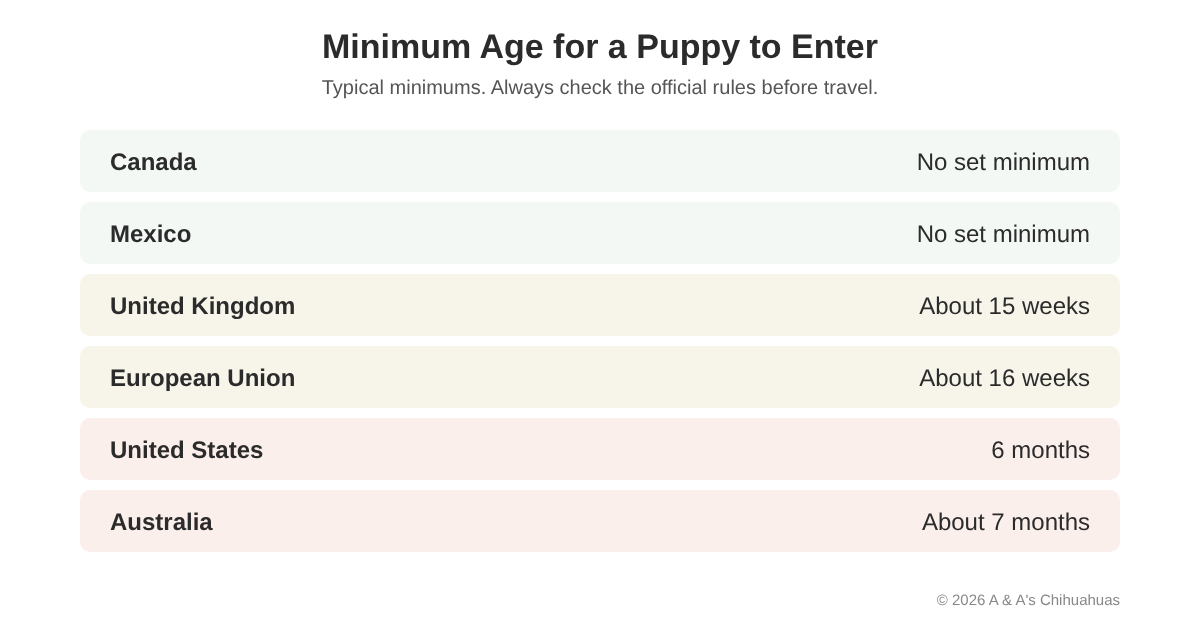
Each country sets its own minimum age:
- Canada: no set minimum. Under 3 months, bring proof of age.
- Mexico: no set minimum.
- United Kingdom: about 15 weeks or older.
- European Union: about 16 weeks or older.
- Australia: about 7 months or older.
- Into the United States: 6 months or older.
The two things that decide your timeline
1. Rabies vaccine age
Many countries require a rabies vaccine, then a waiting period.
A puppy cannot get its first rabies vaccine until about 12 weeks.
2. Pet or commercial import
A puppy you bring home as your own pet is usually a personal import.
Some countries treat a puppy that has just been bought, sold, or changed owners as a commercial import.
Commercial imports have more steps.
The USDA health certificate
Many countries require an international health certificate.
- It is filled out by a USDA-accredited veterinarian.
- For many countries, it must also be endorsed by USDA APHIS.
- Most vets now do this online, through the USDA's VEHCS system.
- Timing is strict. Some certificates must be signed within a few days of travel.
This vet visit is an extra cost.
Canada
Canada is the easiest.
Puppies under 3 months
- No rabies vaccine needed.
- Bring proof of age.
Puppies 3 months and older
- Proof of a current rabies vaccine.
Traveling with your puppy
- For a pet traveling with its owner, proof of rabies vaccine (or proof of age) is all that is required.
- A health certificate is not required, but it is a good idea to have one.
Puppy flying on its own, under 8 months
- A health certificate from a licensed vet, issued within 72 hours of arrival.
Commercial imports
Dogs under 8 months imported for breeding, resale, or adoption are commercial.
They need a CFIA import permit, a rabies vaccine at least 28 days before export, parasite treatment, and a scheduled CFIA inspection.
A puppy you buy and bring home as your own pet is not in this group.
Pet or breeding: how the border decides
Canada classifies a dog by the purpose the owner states, not by the dog's age.
This is the same at a land crossing or an airport, and from any country.
- If you are bringing the puppy home as a pet, declare it as a personal pet.
- If you are bringing it in to breed, sell, or place for adoption, it is a commercial import. Get the CFIA import permit before you travel.
- Commercial dogs arriving by air also need a CFIA-approved quarantine facility booked in advance, in case one is needed.
- Not sure? Contact the CFIA before you travel and ask how to declare.
A false declaration is an offence under Canada's Health of Animals Act.
Keep the bill of sale, contract, and vet records on your phone, in case the officer asks.
A printed copy is a good backup.
At the border
- The Canada Border Services Agency inspects your puppy and papers.
- An inspection fee applies.
- Taxes may apply based on the puppy's value and your province.
Mexico
Mexico no longer requires a health certificate or a rabies vaccine for pet dogs.
But a new rule applies because of screwworm.
Since August 3, 2026
- Every pet dog needs a screwworm (NWS) inspection certificate.
- It must be signed by a USDA-accredited vet no more than 5 days before travel.
- It does not need USDA endorsement.
At the border, Mexican officials check that the puppy:
- shows no signs of disease
- has no fleas or ticks
- has no fresh or healing wounds
- has the screwworm certificate
Bring the puppy in a clean carrier.
Bedding, toys, and extra food may be taken and destroyed.
United Kingdom
The UK takes planning.
Minimum age
- Rabies vaccine at 12 weeks or older.
- Then wait at least 21 days before entry.
- So the puppy is at least 15 weeks old when it arrives.
Requirements
- An ISO microchip (15 digits), placed on or before the rabies vaccine
- Rabies vaccine, then the 21-day wait
- Tapeworm treatment by a vet 1 to 5 days before arrival
- A UK health certificate, endorsed by USDA APHIS
A sold puppy is a commercial import
The USDA states that a dog sold as a puppy needs the commercial certificate.
A commercial certificate is valid for only 48 hours, so timing must be exact.
Banned breeds
The UK bans some breeds and types, including the Pit Bull Terrier, Japanese Tosa, Dogo Argentino, Fila Brasileiro, and XL Bully.
Check the UK list before you buy.
European Union
Each EU country follows the same basic rules, with some extras.
Requirements
- An ISO microchip, placed before the rabies vaccine
- Rabies vaccine at 12 weeks or older
- Wait at least 21 days after the first rabies vaccine
- An EU health certificate, endorsed by USDA APHIS
- Arrive within 10 days of the USDA endorsement
Minimum age in practice
The youngest a puppy can usually travel from the U.S. to the EU is:
about 16 weeks
Tapeworm treatment is also required for Ireland, Finland, Malta, and Norway.
Pet or commercial?
Non-commercial rules cover pets traveling with their owner, within 5 days.
A puppy that is being sold or changing owners may fall under the EU's commercial rules, which add steps.
Check with your country's animal health office before you buy.
Australia and New Zealand
These are the hardest.
Plan on many months.
Australia requires:
- A microchip before any rabies vaccine
- A rabies vaccine
- A rabies blood test (titer) at an approved lab
- A wait of 180 days from the date the lab receives the sample
- An import permit
- At least 10 days in government quarantine in Melbourne
Timeline:
at least 6 to 7 months from the first vet visit
So a young puppy cannot go to Australia.
New Zealand has similar long timelines.
Other countries
The USDA keeps a page for every country.
Search "APHIS pet travel" and the country name.
It lists exactly which forms, tests, and timelines apply.
Bringing a dog into the United States
The CDC is the main authority for dogs entering the U.S.
The rules apply to new dogs and to U.S. dogs coming home from a trip.
Why the rules are so strict: the dog strain of rabies
The U.S. and Canada still have rabies, in bats, raccoons, skunks, and foxes.
What they no longer have is the dog strain.
Rabies has variants, each adapted to one kind of animal.
The raccoon variant spreads raccoon to raccoon.
The dog variant spreads dog to dog, and causes most human rabies deaths in the world.
The U.S. was declared free of the dog variant in 2007.
It has come back in on imported dogs more than once.
The CDC rules are built to keep it out.
The same rabies vaccine protects against every variant.
Every dog entering the U.S. must:
- be at least 6 months old
- have a microchip
- arrive healthy
- have a CDC Dog Import Form receipt
There is no exception for puppies.
A dog under 6 months cannot enter the U.S.
Low-risk and rabies-free countries
This includes Canada, Mexico, the UK, the EU, Australia, New Zealand, and Japan.
For a dog that has been only in these countries for the last 6 months:
- The CDC Dog Import Form is the only CDC document needed.
- It is free and takes a few minutes online.
- It can be done the day you travel, and shown on your phone.
- One receipt covers multiple entries for up to 6 months.
- Any airport, land border, or seaport can be used.
High-risk countries
The CDC lists 111 countries and areas as high-risk for the dog strain.
They include most of Africa, much of the Middle East and Asia, Russia, Ukraine, and much of Latin America and the Caribbean.
Brazil, India, Turkey, Thailand, the Philippines, and Egypt are all on the list.
Check the full CDC list before any trip.
The 6-month look-back
A dog that was in a high-risk country at any time in the last 6 months is treated as a high-risk dog.
That is true even if it is coming from Canada or Europe.
For a high-risk dog:
- The microchip must go in before the rabies vaccine, or the vaccine does not count.
- A U.S.-vaccinated dog needs a "Certification of U.S.-Issued Rabies Vaccination," done by a USDA-accredited vet and endorsed by USDA before the dog leaves the U.S.
- A foreign-vaccinated dog needs a vaccination and microchip certification signed by an official government vet.
- It also needs a rabies blood test from a CDC-approved lab, drawn at least 30 days after the vaccine and at least 28 days before travel.
- It can enter only through an airport with a CDC-registered animal care facility, with a paid reservation there.
- Without a passing blood test, the dog is revaccinated and held for 28 days.
These dogs can come in.
It takes months of planning and real cost.
The rules may change
In December 2024, the CDC said it would rewrite the rule after pushback from border states.
The simpler form for low-risk countries came from that.
The 6-month minimum age still applies.
Screwworm (USDA)
Dogs from countries with screwworm, including Mexico, need a certificate from an official government vet.
It must show the dog was inspected within 5 days before travel and is free of screwworm.
In Mexico, an authorized private vet can sign for the government vet.
Dogs imported for resale or adoption
These are commercial imports under the USDA.
They need:
- to be at least 6 months old
- a rabies vaccine at least 30 days before entry, given at 12 weeks or older
- a health certificate from a licensed vet in the exporting country, in English
- a distemper-parvo combination vaccine within the last 12 months
- a USDA import permit, applied for at least 5 business days ahead
A dog imported only as breeding stock, and not resold, is not covered by these resale rules.
Puppies later sold from it may be. Check with USDA Animal Care.
Flying with a puppy
- Most families fly with the puppy in the cabin, in a carrier under the seat.
- Check your airline's rules before you book. Many have limits on puppy age, carrier size, and the number of pets per flight.
- Some airlines do not fly pets on international routes at all.
- A flight nanny can travel with the puppy if you cannot.
- A flight nanny must be licensed or registered with the USDA. Ask for their USDA number before you book.
Ground transport
For Canada and Mexico, many puppies travel by road.
A paid ground transporter must also be licensed or registered with the USDA.
Ask for their USDA number before you book.
A checklist before you buy
- Look up your country on the USDA APHIS pet travel site. Coming into the U.S.? Start with the CDC dog import page.
- Find the minimum age and waiting periods.
- Ask if a sold puppy counts as a commercial import.
- Check your airline's pet rules. Using a flight nanny or ground transporter? Confirm they are USDA licensed.
- Plan the vaccine dates with the breeder and vet, so the puppy is old enough and ready on the right date.
Quick answers
Can I bring a puppy from the U.S. to Canada?
Yes.
Under 3 months, bring proof of age.
3 months and older, bring proof of rabies vaccine.
Do I need a health certificate to take a dog to Mexico?
Not a general one.
Since August 3, 2026, you need a screwworm inspection certificate signed within 5 days of travel.
How old must a puppy be to go to the UK?
About 15 weeks: a rabies vaccine at 12 weeks or older, plus 21 days.
How old must a puppy be to go to Europe?
Usually about 16 weeks.
Can I bring a puppy to Australia?
Yes, but it takes at least 6 to 7 months and includes quarantine.
Can I bring a puppy into the United States?
Not a young one.
Every dog entering the U.S. must be at least 6 months old, microchipped, and have a CDC Dog Import Form.
Why is the U.S. so strict about dogs and rabies?
The U.S. is free of the dog-to-dog strain of rabies.
The rules keep imported dogs from bringing it back.
Key takeaways
- These rules apply to every breed. Breeders and buyers must follow them.
- Canada and Mexico can take a young puppy.
- Canada classifies a dog as pet or commercial by the purpose the owner declares, by land or air.
- The UK and Europe need a rabies vaccine plus 21 days, so about 15 to 16 weeks or older.
- Australia takes at least 6 to 7 months.
- A sold puppy may count as a commercial import. The UK says it does.
- Since August 3, 2026, Mexico requires a screwworm certificate.
- Every dog entering the U.S. must be at least 6 months old, microchipped, and have a CDC Dog Import Form.
- Dogs from high-risk rabies countries need a blood test, special airports, and may need 28 days of quarantine.
- The U.S. rules target the dog strain of rabies, not the wildlife strains already here.
- Flight nannies and paid ground transporters must be USDA licensed or registered.
- Always check the official rules for your country before you travel.
Official sources
- USDA APHIS. Pet travel from the United States to Canada.
- USDA APHIS. Pet travel from the United States to Mexico.
- USDA APHIS. Pet travel from the United States to the United Kingdom.
- USDA APHIS. Pet travel from the United States to the European Union (by country).
- Canadian Food Inspection Agency. Import rules for commercial dogs less than 8 months old (2021).
- Canada Border Services Agency. Importing pets.
- USDA APHIS. Bring a pet dog into the United States (updated April 2026).
- USDA APHIS. How to bring dogs into the United States for commercial sale or adoption.
- Centers for Disease Control and Prevention. Bringing a dog into the United States.
- Centers for Disease Control and Prevention. High-risk countries for dog rabies (updated April 15, 2026).
- European Commission. Movement of pets into the EU.
- Australian Department of Agriculture. Bringing cats and dogs to Australia (BICON).
© 2026 A & A's Chihuahuas and Rev. T. Stringer. All rights reserved.
This educational content may not be reproduced without permission.
- Puppies
- Travel
- International