
Why a Well-Bred Puppy Costs More Up Front and Less Over Its Life
Rev. T. Stringer · · 8 min read

By Rev. T. Stringer, Lead Researcher, SIPGS
A puppy from an ethical, health-testing breeder costs more on day one.
Over the dog's life, it often costs less.
The reason is simple.
The purchase price is paid once.
Vet bills for inherited problems can last for years.
This post shows where that money goes, and why paying more up front can save you thousands later.
Your three choices
1. A well-bred puppy from an ethical breeder
- Both parents are health tested, with results you can see.
- You know the family health history.
- You know the adult size.
- You get a contract and a breeder who stays with you for the dog's life.
Costs more up front.
The lowest risk of costly inherited problems.
2. A cheap puppy with no health testing
- No tests on the parents.
- Little or no family history.
- Often no contract and no support.
Costs less up front.
The risk of costly inherited problems moves to you.
3. A rescue
- The parents are usually unknown.
- No health testing on the parents.
- Breed and adult size are often a guess.
Not always cheap.
Shelters often charge $50 to $250.
Private rescues often charge $150 to $600, and some charge $600 to $1,200.
The fee usually covers spay or neuter, vaccines, a microchip, and a vet check.
It does not cover anything about the parents' health.
Many rescue dogs make wonderful pets.
Go in knowing what you can and cannot know.
The bills come later
Most of what a dog costs comes after it goes home.
The biggest bills are often for problems that run in families.
And those bills are rising fast.
U.S. vet prices are up about:
49% since 2020
Why so high?
Costlier medicine and equipment, higher drug and staff costs, and more clinics owned by corporations and private equity.
About 75% of specialty and emergency hospitals are now corporate owned.
In the UK, large corporate vet groups were found to charge about 18% more than independent clinics.
In 2025, a Gallup study found:
- 52% of pet owners skipped or declined care their pet needed.
- 66% could pay $1,000 or less for lifesaving treatment.
Most inherited problems cost far more than that.
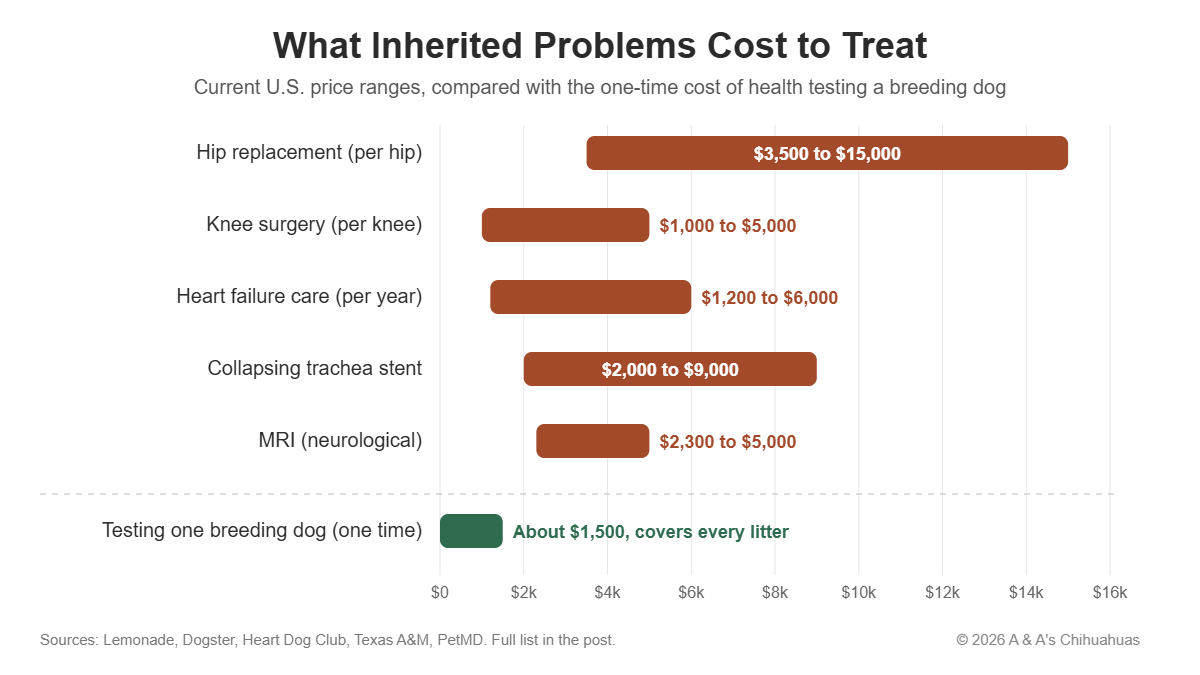
What inherited problems cost to treat today:
Hip replacement: $3,500 to $15,000 per hip
Knee surgery: $1,000 to $5,000 per knee
Heart failure care: $1,200 to $6,000 a year, for life
Collapsing trachea stent: $2,000 to $9,000
MRI for a neurological problem: $2,300 to $5,000 or more
One of our own dogs had an MRI in 2025 at a specialty neurology practice in upstate New York.
The bill was:
$6,500
Do the math
Say a well-bred puppy costs $2,000 more than a cheap one.
One knee surgery can cost $1,000 to $5,000.
Many dogs need both knees done: $2,000 to $10,000.
One inherited problem can wipe out the savings of a cheap puppy.
Two or three can cost many times the purchase price.
A small dog with bad knees, a neurological problem, and a collapsing trachea could cost:
$4,800 to $17,000
A large dog that needs both hips replaced could cost:
$7,000 to $30,000
That is before medication, follow-up visits, or emergency care.
Pet insurance: protect yourself from day one
More than 95% of U.S. dogs and cats have no pet insurance.
With vet prices where they are, that is a big risk.
How it helps:
- Most plans pay back a large share of the bill after a deductible.
- It turns a $6,500 surprise into a bill you can plan for.
- You can say yes to the care your vet recommends, instead of choosing by price.
Why the first weeks matter:
- Insurance does not cover pre-existing conditions. Anything that shows signs before coverage starts, or during a waiting period, can be excluded for life.
- Most plans have a waiting period. Illness coverage often starts after 14 to 30 days.
- Knee and hip problems can have waiting periods of 6 months or longer with some plans.
- The younger the dog when you enroll, the less history there is to exclude.
Our puppies go home already covered.
A & A's Chihuahuas is part of Trupanion's breeder program.
Every puppy that leaves here comes with a free Trupanion offer that starts right away, with the usual waiting periods waived.
It must be activated within 24 hours of the puppy going home.
Coverage details depend on the state you live in.
We do this because we want our families protected from the first day, not after a waiting period.
Keep coverage going after the offer ends, and you avoid gaps that can turn a new problem into a pre-existing one.
Pick the plan that fits your family.
What matters most is different for every family.
- Some want help with accidents and emergencies they do not have savings for.
- Some want help with routine wellness, like checkups and vaccines.
- Some want both.
Trupanion covers accidents and illnesses.
If you also want help with routine care, other companies offer wellness coverage or plans that do it all.
We encourage every family to look into pet insurance and choose what fits their needs.
Where your money goes with a well-bred puppy
Health testing on the parents.
Each breed club sets the tests it recommends, such as hips, elbows, knees, heart, and eyes, plus a DNA panel.
For our dogs, that is about $1,500 per adult dog, plus about $50 a year for eye exams.
It is paid before the dog is ever bred, and it protects every puppy in every litter that dog produces.
DNA testing goes much further than exams.
A DNA result never changes.
It tells you for certain if a dog is clear, a carrier, or at risk for the conditions tested.
It also confirms the breed and predicts adult size.
Both are needed.
Exams check hips, knees, hearts, and eyes, which DNA cannot.
DNA finds hidden genes, which exams cannot.
And the results have to be read and understood, not just collected.
Knowing what you are getting.
We have seen families told a rescue puppy was a toy breed.
Six months later, it weighed 50 lbs, in a home that did not allow large dogs.
In one study, only 25% of shelter dogs labeled with a main breed actually had that breed as their main breed by DNA.
A breeder who stays.
A contract, records, and someone to call for the life of the dog.
What testing cannot do
Testing lowers the odds. It is not a guarantee.
No breeder can promise a dog will never get sick.
An exam shows how the dog was on the day of the exam.
It cannot stop an injury.
A jump off the couch can still make a healthy knee luxate.
Better odds, generation after generation, is the goal.
How to tell a well-bred puppy
Ask for:
- The registered names of both parents
- Their health results, which you can look up yourself at ofa.org
- Their DNA reports
- What health problems show up in the family
Red flags:
- "AKC champion lines" offered in place of health results. Almost every registered dog has a champion somewhere in its pedigree, even the worst-bred dogs. A title judges looks, not health.
- "I know my lines" in place of test results
- A breeder who says OFA or DNA testing is not needed, or talks it down
- No results you can look up yourself
- More talk about price, color, or size than health
- No written health guarantee
- No written contract
For a rescue:
DNA test the dog. At about $139 to $199, it costs far less than finding a new home for a dog that outgrew yours.
Watch for "puppy laundering," where puppy mill dogs are sold through fake rescues. The ASPCA warns their fees can reach thousands of dollars.
Quick answers
Why does a well-bred puppy cost more?
The breeder pays for health exams and DNA tests on both parents before the puppy is born.
Will a well-bred puppy save me money?
Often, yes.
One surgery for an inherited problem can cost more than the price difference.
Is a rescue cheaper?
Not always.
Fees run $50 to $1,200, and the parents' health is usually unknown.
Is pet insurance worth it?
For many families, yes.
Enroll as young as possible, before anything can count as pre-existing.
Every A & A's puppy goes home with a free Trupanion offer that starts right away.
Does health testing guarantee a healthy dog?
No.
It lowers the odds of inherited problems. It cannot prevent injuries.
Why are vet bills so high now?
U.S. vet prices are up about 49% since 2020.
Over half of pet owners skipped needed care in 2024, mostly because of cost.
Key takeaways
- A well-bred puppy costs more up front, but often costs less over its life.
- The purchase price is paid once. Vet bills for inherited problems can last for years.
- One knee surgery can cost $1,000 to $5,000. One hip replacement can cost $3,500 to $15,000.
- Vet prices are up about 49% since 2020.
- Two-thirds of pet owners can pay $1,000 or less for lifesaving care.
- Health testing lowers the odds. DNA testing goes further. Both are needed.
- Rescue fees can reach $1,200, with no health history on the parents.
- Insure your puppy young. Pre-existing conditions are not covered. Our puppies go home with a free Trupanion offer that starts right away.
- Look up the parents yourself at ofa.org.
Sources
- U.S. Bureau of Labor Statistics. Consumer Price Index, veterinarian services.
- PetSmart Charities and Gallup. State of Pet Care study (April 2025).
- Lemonade. Dog hip dysplasia surgery cost (updated Oct. 2026).
- Dogster. Patellar luxation surgery cost (updated Sept. 2026).
- Heart Dog Club. CHF in dogs: treatment costs.
- Texas A&M Veterinary Medical Teaching Hospital. Tracheal stenting information sheet.
- Embrace Pet Insurance. Tracheal collapse.
- PetMD. MRIs for dogs.
- Philadelphia Inquirer / Capital & Main. Why so many pet owners can't afford a veterinarian (Oct. 31, 2026).
- PBS NewsHour. As veterinary costs climb, private equity ownership of clinics draws scrutiny (July 1, 2026).
- dvm360. U.S. pet insurance enrollment, NAPHIA 2026 data (July 2026).
- NerdWallet. Pet insurance waiting periods.
- AKC Pet Insurance. Understanding pre-existing conditions.
- Trupanion. Go Home Day offer.
- Adopt-a-Pet. Pet adoption fees (2025).
- Buddy. How much is it to adopt a dog in NYC?
- Sniffspot. How much does it cost to adopt a dog?
- Voith VL, et al. (2009). Comparison of adoption agency breed identification and DNA breed identification of dogs. Journal of Applied Animal Welfare Science, 12(3):253-262.
- ASPCA. Scam alert: what is puppy laundering?
- Embark Veterinary. Purebred Dog DNA Test product page.
- Orthopedic Foundation for Animals. ofa.org.
© 2026 A & A's Chihuahuas and Rev. T. Stringer. All rights reserved.
This educational content may not be reproduced without permission.
- Puppy Buyers
- Health
- Health Testing
- Rescue
- Vet Costs
- Pet Insurance