
When to Spay or Neuter a Dog: Growth Plates, Hormones, and the Research by Size
Rev. T. Stringer · · 10 min read

By Rev. T. Stringer, Lead Researcher, SIPGS
The short answer:
Wait until your dog's growth plates have closed.
Not a birthday. Not a guess. Closure.
Ask your vet for an X-ray to confirm it before you schedule surgery.
When that happens depends on your dog's size.
So do the risks of altering too early.
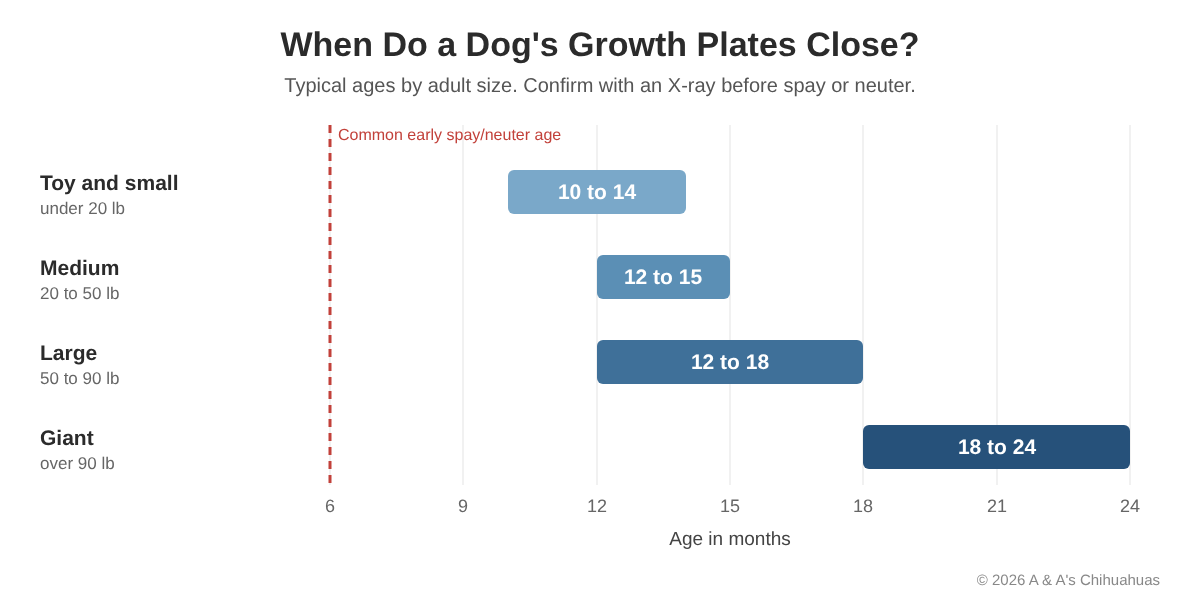
Typical ranges. Your dog's X-ray is the real answer.
What a growth plate is
A growth plate is a band of cartilage near the end of a long bone.
It is where the bone gets longer.
When growth is done, the cartilage turns to bone.
The plate closes.
How sex hormones close the plates
Sex hormones are the signal that tells growth plates to close.
Estrogen does this in both males and females.
Remove the ovaries or testicles early, and the signal is gone.
The plates stay open longer.
The bones keep growing.
In a 1991 study, puppies neutered early had later growth plate closure and longer leg bones than intact puppies.
Longer bones change the angles of the joints.
That changes how the joints wear for the rest of the dog's life.
When growth plates close, by size
These are typical ages.
Individual dogs vary.
Toy and small dogs, under 20 lb
About 10 to 14 months.
In our own Chihuahuas, we see closure around 12 to 14 months.
Medium dogs, 20 to 50 lb
About 12 to 15 months.
Large dogs, 50 to 90 lb
About 12 to 18 months.
Giant dogs, over 90 lb
About 18 to 24 months.
Bigger dogs grow longer.
The bigger the dog, the more it costs to remove the hormones early.
What the research says
The largest work on this comes from UC Davis.
Drs. Benjamin and Lynette Hart have studied neutering age in:
- 35 breeds (2020)
- mixed-breed dogs, by weight (2020)
- 40 breeds, adding 5 more (2024)
They looked at three joint disorders:
- hip dysplasia
- torn cruciate ligament (the dog's ACL)
- elbow dysplasia
And four cancers:
- lymphoma
- mast cell tumor
- hemangiosarcoma
- osteosarcoma
Large breeds
In Golden Retrievers, Labradors, and German Shepherds, neutering before 1 year was linked to:
2 to 4 times the risk of joint disorders
The risk was highest in dogs neutered by 6 months.
Mixed-breed dogs
Dogs 20 kg (44 lb) and over: neutering before 1 year was linked to more joint disorders.
Dogs under 20 kg: no added risk for the joint disorders or cancers studied.
Small breeds
Small breeds showed no added risk for those three joint disorders.
Only the Boston Terrier and Shih Tzu showed more cancer with neutering.
Breed by breed
The 2024 update set minimum ages for some breeds. Examples:
- Mastiff: males 24 months, females 12 months
- Newfoundland: 12 months
- German Shorthaired and Wirehaired Pointer: 12 months
- Siberian Husky: males 6 months, females 12 months
- Shetland Sheepdog females: 24 months, to lower the risk of leaking urine
What the research did not study: the knee
The UC Davis work did not look at the kneecap.
Patellar luxation, a kneecap that slips, is the most common joint problem in small dogs.
A large UK study found higher odds of patellar luxation in:
- neutered dogs
- females
- dogs below their breed's average weight
So "no added joint risk in small dogs" means no added risk of hips, elbows, and cruciates.
It does not clear the knee.
Whether the kneecap tracks right depends on the length and angles of the thigh and shin bones.
Those are set when the growth plates close.
In a small dog, the knee has almost no margin.
Hormones, Cushing's, and diabetes
When the ovaries or testicles are removed, a hormone called luteinizing hormone (LH) rises.
It stays high for life.
LH receptors are found in tissues outside the reproductive tract, including the adrenal glands.
Constant high LH is a proposed link to:
- Cushing's disease
- diabetes, separate from weight gain
Population studies point the same way:
- In 21,281 dogs, neutered dogs had 2.54 times the odds of Cushing's.
- In a UK study, neutered males had a higher risk of diabetes than intact males.
We see this in our own records too.
We keep lifetime health records on our dogs.
The ones altered too early show up more often among our orthopedic, Cushing's, and diabetes cases.
Cancer: breed-specific, not universal
You may read that early spay or neuter causes cancer.
That depends on the breed.
- Female Golden Retrievers had 2 to 4 times the cancer risk when spayed at any age.
- In most small breeds, and in mixed-breed dogs of all sizes, the studied cancers were not higher.
We will not claim a cancer risk that the data for your dog's size and breed does not support.
The real benefits of spaying and neutering
Altering has real benefits too.
Waiting is about timing, not about never.
Pyometra
A life-threatening infection of the uterus in intact females.
In Swedish insurance data, it affected:
19% to 25% of intact females by age 10
In some breeds, it was over 50%.
Spaying prevents it.
Mammary tumors
The old claim is that spaying before the first heat almost eliminates breast cancer.
A 2012 systematic review found that evidence weak and at risk of bias.
Spaying may lower the risk, but the size of the effect is not proven.
No unplanned litters
Testicles
- No testicular cancer.
- Fewer prostate problems.
Retained testicles
A testicle that never dropped (cryptorchid) should be removed.
It has a higher risk of cancer and can twist.
Other effects of early altering
- Leaking urine in spayed females, especially in some breeds.
- Weight gain. Metabolism drops. Feed for the dog in front of you, not the bag.
- Less muscle. Sex hormones build muscle.
What about the 6-month advice?
Many vets still recommend spay or neuter at about 6 months for small dogs.
That comes from the AAHA 2019 guidelines.
The science does not support it.
AAHA's reasons for early spay in small dogs:
- fewer mammary tumors
- no unplanned litters
What the evidence shows:
- The mammary tumor benefit rests on studies a 2012 systematic review called weak and at risk of bias.
- Unplanned litters are prevented by management, not surgery.
- At 6 months, a small dog's growth plates are still open. Removing the hormones then delays closure and changes bone length.
- The studies that found "no added joint risk" in small dogs never looked at the knee. Patellar luxation is the main joint problem in small dogs, and neutered dogs have higher odds of it.
- Neutered dogs have higher odds of Cushing's disease.
No study shows that altering a small dog at 6 months is better for the dog than waiting until growth is done.
AAHA already says to wait until growth stops in large dogs.
The same biology applies to small dogs.
Education, not assumption
Early spay and neuter grew out of shelter medicine and population control.
The starting point is that owners cannot be trusted to manage an intact dog.
Much of veterinary training still teaches it that way.
We start from a different place.
We believe in educating owners and in responsible dog ownership.
An owner who knows how to manage a heat, keeps the dog leashed, and plans the surgery for the right time is not a risk.
That owner can give the dog the best timing for its body.
Look at Scandinavia
In Norway, the law does not allow surgery on a healthy dog just for convenience.
Routine spay and neuter is not done.
Norway's food safety authority has said the country has no stray dogs.
In a Swedish study of insured young dogs, aged 1 to 3:
98.9% were intact
Compare that with about 64% of dogs neutered in the United States, and 54% in the UK.
These countries do not have a stray or unwanted-litter problem.
The difference is owner education and responsibility, not surgery.
The trade-off is real: more intact females means more pyometra, so owners there watch for it and spay when it is medically needed.
Your vet may have a reason to recommend a different timeline for your dog.
Hear it.
Then ask one question:
"Can we confirm the growth plates are closed before we schedule this?"
If you want to alter and keep the hormones
Ovary-sparing spay (females)
The whole uterus comes out. The ovaries stay.
- No pregnancy.
- No pyometra, if the whole uterus is removed.
- She keeps her hormones.
- She will still come into heat and attract males.
Vasectomy (males)
He keeps his testicles and his hormones.
He cannot sire puppies.
He keeps normal male behavior.
Not every practice offers these.
Ask.
Her first heat: what to do
Most females have their first heat between 6 and 12 months.
Small dogs often come in earlier, large dogs later.
A heat is not an emergency.
It lasts about 2 to 3 weeks.
- Use a doggie diaper. We make custom ones sized for small dogs.
- A heating pad on low under her bedding helps with cramping.
- Keep her on a leash outside, every time.
- No dog parks, daycare, or intact males for the full cycle.
Not normal:
Foul discharge, lethargy, heavy drinking, or fever.
That is a vet visit now.
Notes for toy breeds
- Ask about short fasting before surgery. Toy dogs can drop their blood sugar. See our post on hypoglycemia.
- Ask the vet to check for retained baby teeth. They can be pulled under the same anesthesia.
- Keep the dog warm during recovery. Small bodies lose heat fast.
Quick answers
What age should I spay or neuter my dog?
When the growth plates have closed, confirmed by X-ray.
For most dogs that is between 10 and 24 months, depending on size.
Is it OK to neuter a small dog at 6 months?
Small dogs showed no added risk of hip, elbow, or cruciate problems.
The knee was not studied, and neutered dogs have higher odds of a slipping kneecap.
We recommend waiting for closure.
What age should I neuter a large breed dog?
Not before 1 year.
Some giant breeds, like Mastiff males, not before 2 years.
Does early spaying cause cancer?
In some breeds, like Golden Retrievers.
Not in most small breeds or in mixed-breed dogs.
Does spaying prevent mammary cancer?
It may lower the risk.
The evidence is weaker than most people think.
Is there a way to sterilize a dog and keep the hormones?
Yes. Ovary-sparing spay for females, and vasectomy for males.
Key takeaways
- Wait for growth plate closure, confirmed by X-ray.
- Small dogs close around 10 to 14 months. Giant dogs can take 18 to 24 months.
- Sex hormones close the growth plates. Remove them early, and bones grow longer.
- Large dogs neutered before 1 year had 2 to 4 times the risk of joint disorders.
- Small dogs showed no added risk of hip, elbow, or cruciate problems. The knee was not studied.
- Neutered dogs have higher odds of patellar luxation and Cushing's disease.
- Cancer risk depends on breed.
- Pyometra affects 19% to 25% of intact females by age 10. Spaying prevents it.
- The mammary tumor benefit is weaker than claimed.
- Ovary-sparing spay and vasectomy keep the hormones.
Sources
- Salmeri KR, Bloomberg MS, Scruggs SL, Shille V. (1991). Gonadectomy in immature dogs: effects on skeletal, physical, and behavioral development. JAVMA, 198(7):1193-1203.
- Hart BL, Hart LA, Thigpen AP, Willits NH. (2020). Assisting decision-making on age of neutering for 35 breeds of dogs: associated joint disorders, cancers, and urinary incontinence. Frontiers in Veterinary Science, 7:388.
- Hart BL, Hart LA, Thigpen AP, Willits NH. (2020). Assisting decision-making on age of neutering for mixed breed dogs of five weight categories: associated joint disorders and cancers. Frontiers in Veterinary Science, 7:472.
- Hart BL, Hart LA, Thigpen AP, Willits NH. (2024). Assisting decision-making on age of neutering for German Short/Wirehaired Pointer, Mastiff, Newfoundland, Rhodesian Ridgeback, Siberian Husky: associated joint disorders, cancers, and urinary incontinence. Frontiers in Veterinary Science, 11:1322276.
- O'Neill DG, et al. (2016). The epidemiology of patellar luxation in dogs attending primary-care veterinary practices in England. Canine Genetics and Epidemiology, 3:4.
- Kutzler MA. (2020). Possible relationship between long-term adverse health effects of gonad-removing surgical sterilization and luteinizing hormone in dogs. Animals, 10(4):599.
- Carotenuto G, et al. (2019). Cushing's syndrome: an epidemiological study based on a canine population of 21,281 dogs. Open Veterinary Journal, 9(1):27-32.
- Mattin MJ, et al. (2014). An epidemiological study of diabetes mellitus in dogs attending first opinion practice in the UK. Veterinary Record, 174(14):349.
- Beauvais W, Cardwell JM, Brodbelt DC. (2012). The effect of neutering on the risk of mammary tumours in dogs: a systematic review. Journal of Small Animal Practice, 53(6):314-322.
- Sallander M, Hedhammar Å, Rundgren M, Lindberg JE. (2001). Demographic data of a population of insured Swedish dogs measured in a questionnaire study. Acta Veterinaria Scandinavica, 42:71-80.
- Dog Neuter, Yes or No? A summary of the motivations, benefits, and harms, with special emphasis on the behavioral aspect. (2025). Animals, 15(7).
- Science Norway. (2011). Should dogs be neutered?
- Jitpean S, et al. (2012). Breed variations in the incidence of pyometra and mammary tumours in Swedish dogs. Reproduction in Domestic Animals, 47(Suppl 6):347-350.
- AAHA. (2019). Canine Life Stage Guidelines: Spay and neuter timing.
© 2026 A & A's Chihuahuas and Rev. T. Stringer. All rights reserved.
This educational content may not be reproduced without permission.
- Health
- Spay and Neuter
- Puppies