
High Blood Pressure in Dogs: Normal Numbers, Symptoms, and Treatment
Rev. T. Stringer · · 6 min read

By Rev. T. Stringer, Lead Researcher, SIPGS
Normal blood pressure for a dog is under 140 mmHg (the top number).
160 or higher is high blood pressure.
High blood pressure is called hypertension.
In dogs, it is usually a sign that something else is wrong.
It causes damage quietly.
The first sign is often sudden blindness.
The good news: it can be measured, and it can be treated.
What is normal blood pressure for a dog?
Blood pressure is measured in mmHg.
In dogs, the top number, systolic pressure, is the one that matters most.
The American College of Veterinary Internal Medicine (ACVIM) sorts dogs into four groups:
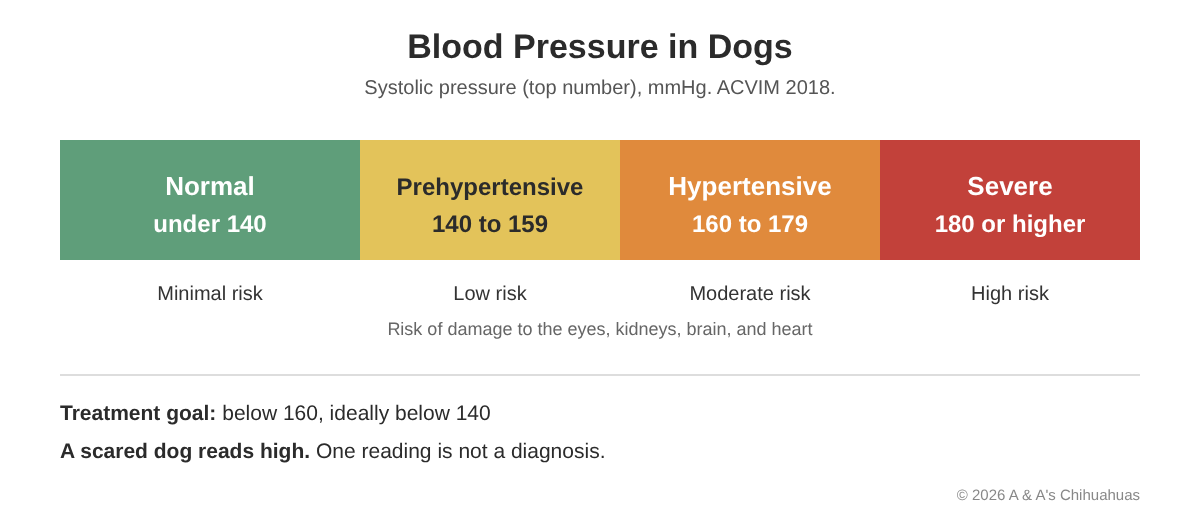
Under 140: Normal
Little or no risk of damage.
140 to 159: Prehypertensive
Low risk. Recheck.
160 to 179: Hypertensive
Moderate risk of damage.
180 or higher: Severely hypertensive
High risk of damage.
Are some breeds more likely to have high blood pressure?
Sighthounds, such as Greyhounds, normally run higher.
Their readings are often about 20 mmHg above other breeds.
A vet should judge them on their own scale.
For most other breeds, the same numbers apply.
Size does not change what is normal.
Most high blood pressure is found in older dogs.
Do not confuse it with heart valve disease.
Many small breeds get mitral valve disease, a leaky heart valve.
That is a different problem.
A murmur is not high blood pressure, but a dog can have both.
What causes high blood pressure in dogs?
In most dogs, high blood pressure comes from another disease.
This is called secondary hypertension.
Diseases linked to it, with the share of dogs in published studies who had high blood pressure:
- Cushing's disease: about 20% to 80%
- Diabetes: 24% to 67%
- Chronic kidney disease: 9% to 93%
- Sudden kidney injury: up to 87%
- Pheochromocytoma, an adrenal tumor: 43% to 86%
The ranges are wide because each study measured different groups of dogs.
Medicines that can raise it:
- steroids, at high doses
- phenylpropanolamine (Proin), used for leaking urine
- decongestants such as pseudoephedrine
- some cancer drugs
- drugs that boost red blood cells
When no cause is found, it is called idiopathic hypertension.
That is the less common type in dogs.
What does high blood pressure do to a dog?
High pressure harms the organs with the smallest blood vessels.
Eyes
- bleeding in the eye
- a detached retina
- sudden blindness
Kidneys
- protein leaking into the urine
- faster kidney decline
Brain
- confusion or wobbliness
- head tilt
- seizures
Heart
- a thickened heart wall
- a new murmur or abnormal rhythm
Symptoms of high blood pressure in dogs
Most dogs show no signs until damage is done.
Watch for:
- bumping into things, or sudden blindness
- pupils that stay large in bright light
- blood in the eye
- drinking and urinating more
- confusion, a head tilt, or a seizure
Sudden blindness is an emergency.
Fast treatment can sometimes save sight.
How a vet measures a dog's blood pressure
Getting a true reading takes care, especially in small dogs.
A scared dog in a cold clinic will read high.
ACVIM recommends:
- A quiet room, away from other animals.
- The owner present if possible.
- 5 to 10 minutes for the dog to settle first.
- A cuff about 30% to 40% of the leg or tail's width around.
- The same trained person taking each reading.
- Throwing out the first reading.
- Averaging the next 5 to 7 readings.
- No sedation.
Cuff size matters.
A cuff that is too small reads falsely high.
A cuff that is too large reads falsely low.
Tiny legs need tiny cuffs.
A high reading from fear is not hypertension.
This is called situational, or "white coat," hypertension.
ACVIM says it should not be treated.
One high reading is not a diagnosis.
It should be confirmed on more than one visit, unless the dog already shows damage.
Which dogs should have their blood pressure checked?
- Dogs with kidney disease, Cushing's, or diabetes
- Dogs on medicines that raise blood pressure
- Dogs with signs in the eyes, brain, or kidneys
- Senior dogs, at regular checkups
Treatment for high blood pressure in dogs
First, treat the cause.
Controlling Cushing's or diabetes can bring the pressure down.
Medicine
Common choices in dogs:
- An ACE inhibitor, such as enalapril or benazepril
- An angiotensin blocker, such as telmisartan
- Amlodipine, often added when one drug is not enough
These are usually the first choice when the dog also has protein in the urine.
Goals
- Below 160
- Ideally below 140
Follow-up
- Recheck 1 to 2 weeks after starting or changing a dose.
- Then every 3 months once stable.
- Weakness or fainting after starting medicine can mean the pressure dropped too low.
Can I check my dog's blood pressure at home?
Not reliably.
Home cuffs made for people do not fit a dog's leg, especially a small dog's.
Most have not been tested in dogs.
ACVIM says to use only devices tested in awake dogs.
A vet clinic with a Doppler unit and small cuffs gives the most accurate reading.
Can dogs take human blood pressure medicine?
Never give your dog your own blood pressure pills.
Doses for people can drop a dog's pressure dangerously low.
Some of the same drugs, like amlodipine and enalapril, are used in dogs.
The dose is set by the dog's weight, by a vet.
My dog ate a blood pressure pill
This is an emergency.
For a small dog, one human pill can be a very large dose.
Signs can include:
- weakness or collapse
- pale gums
- a slow or very fast heartbeat
- vomiting
- low blood sugar, with some drugs. See our post on hypoglycemia.
Call your vet, or a pet poison line, right away.
Have the pill bottle in your hand.
ASPCA Animal Poison Control:
(888) 426-4435
Pet Poison Helpline:
(855) 764-7661
Both may charge a fee.
What you can do at home
- Keep your dog lean. Extra weight has a small effect, but it adds up.
- Ask before giving any decongestant or human cold medicine.
- Do yearly bloodwork and urine tests in seniors. Kidney disease often shows there first.
- Bring your dog to blood pressure checks calm, and warm.
Quick answers
What is normal blood pressure for a dog?
Under 140 mmHg, the top number.
Sighthounds often run about 20 higher.
What blood pressure is too high for a dog?
160 or higher is high.
180 or higher is severe.
What is the first sign of high blood pressure in dogs?
Often there is none.
Sudden blindness is a common first sign.
What causes high blood pressure in older dogs?
Most often kidney disease, Cushing's disease, or diabetes.
Why was my dog's reading high at the vet?
Fear raises it.
One high reading is not a diagnosis.
Key takeaways
- Normal is under 140. 160 or higher is hypertension. 180 or higher is severe.
- In dogs, it is usually caused by another disease: kidney disease, Cushing's, or diabetes.
- The same numbers apply to most breeds. Sighthounds normally run higher.
- It quietly damages the eyes, kidneys, brain, and heart.
- Sudden blindness can be the first sign. Treat it as an emergency.
- A frightened dog reads high. One reading is not a diagnosis.
- Small dogs need the right size cuff.
- Treat the cause first. Medicine goal is below 160, ideally below 140.
- Never give a dog human blood pressure pills. A swallowed pill is an emergency.
Sources
- Acierno MJ, Brown S, Coleman AE, et al. (2018). ACVIM consensus statement: Guidelines for the identification, evaluation, and management of systemic hypertension in dogs and cats. Journal of Veterinary Internal Medicine, 32(6):1803-1822.
- Brown S, Atkins C, Bagley R, et al. (2007). Guidelines for the identification, evaluation, and management of systemic hypertension in dogs and cats. Journal of Veterinary Internal Medicine, 21:542-558.
© 2026 A & A's Chihuahuas and Rev. T. Stringer. All rights reserved.
This educational content may not be reproduced without permission.
- Health
- Senior Dogs